
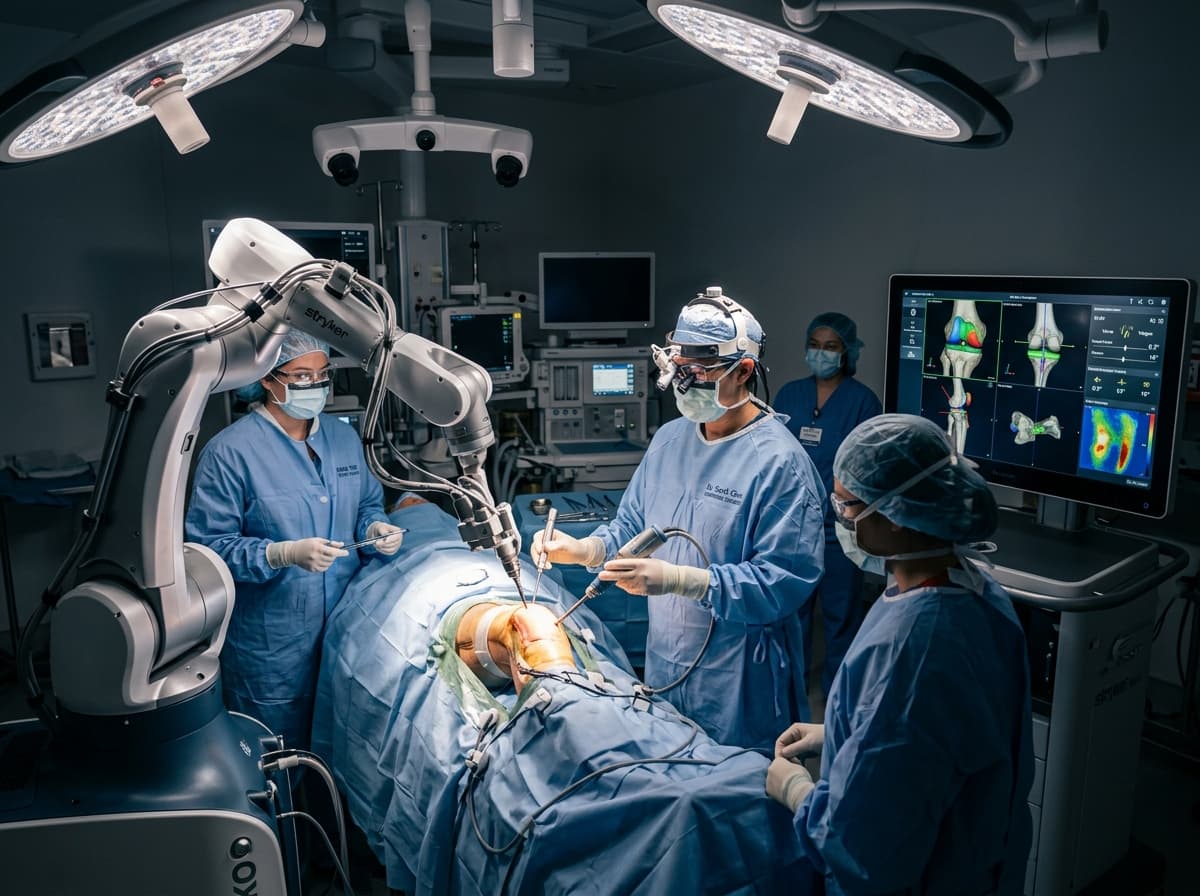

Understanding Robotic-Assisted Joint Replacement
Osteoarthritis, rheumatoid arthritis, or severe post-traumatic joint degeneration causes progressive cartilage erosion, leading to persistent bone-on-bone friction, severe pain, angular deformity (bow legs or knock knees), and restricted mobility. When conservative measures fail, robotic-assisted knee replacement provides unprecedented precision by mapping the patient's individual joint geometry in 3D, allowing exact implant positioning and balanced soft-tissue tension.
The Robotic Arthroplasty Advantage
Unlike traditional manual joint replacements that rely on generic cutting blocks, robotic assistance provides a customized virtual 3D CT model of your specific bone geometry, enabling the surgeon to preserve healthy native bone and maintain balanced ligament tension throughout full motion.
When Should You Consider Consultation for Robotic Joint Replacement?
Specialist intervention is considered when joint pain or functional limitation significantly disrupts your daily life and conservative measures have been exhausted. Check if you experience any of the following:
Severe knee pain that limits daily activities such as walking, climbing stairs, or standing up from a chair.
Moderate or severe pain while resting, either day or night.
Chronic knee inflammation and swelling that does not improve with rest or medications.
Knee deformity, such as bowing in or out of the joint.
Knee stiffness or inability to bend and straighten the joint fully.
Failure to obtain satisfactory pain relief from physical therapy, weight management, or intra-articular injections.

Dr. Vijay Kumar
Verified SpecialistSenior Consultant Orthopaedic, Robotic Joint Replacement & Complex Articular Trauma Surgeon
“Every robotic joint replacement is planned on a high-precision 3D digital model of your natural limb alignment. This constitutional balancing ensures that native collateral ligaments remain relaxed and intact, delivering a natural, pain-free walking sensation from day one.”
Robotic vs Conventional Joint Arthroplasty
See how sub-millimetre robotic technology transforms surgical precision, safety, and recovery compared to standard manual surgery:
| Clinical Parameter | ✨ Advanced Robotic Arthroplasty | Conventional Manual Surgery |
|---|---|---|
| 3D Pre-Operative Planning | CT-guided 3D digital virtual model matches patient-specific anatomy | 2D static X-ray estimates with standard sizing charts |
| Bone Resection Precision | Sub-millimetre (0.5 mm) accuracy governed by robotic haptic arm | Manual cutting blocks with potential alignment variance |
| Soft-Tissue & Ligament Balancing | Real-time dynamic sensors verify tension through full arc of motion | Subjective surgeon manual feel with gap-spacer blocks |
| Safety & Boundary Protection | Haptic boundary limits automatically prevent saw damage to vessels | Relies solely on manual retractor placement and surgeon sight |
| Post-Operative Ambulation | Same-day or 24-hour assisted walking with minimal tissue trauma | 2 to 4 days bed rest before initiating full weight-bearing |
| Implant Longevity & Natural Feel | Constitutional alignment optimizes wear distribution for 25+ years | Mechanical axis alignment may feel stiffer to some patients |
The 4-Stage Precision Clinical Workflow
3D Virtual Anatomical Pre-Plan
Pre-operative or intra-operative CT/imageless 3D kinematic mapping of your unique knee anatomy.
Dynamic Intraoperative Kinematic Mapping
Real-time intra-operative computer simulation to balance soft tissue laxity throughout full range of motion.
Haptic Robotic Arm Execution
Robotic arm guidance that strictly confines bone resection within the planned boundary, preserving healthy bone and collateral ligaments.
Biocompatible Implant Seating & Fast Mobilization
Precise fixation of biocompatible implants designed for smooth, anatomical gliding movement.
Treatment Modalities Offered
Dr. Vijay Kumar practices conservative joint-sparing protocols first, proceeding to advanced surgical intervention only when indicated:
Non-Surgical & Joint Sparing
- Structured quadriceps and hamstring strengthening therapy
- Activity modification and low-impact conditioning
- Non-steroidal anti-inflammatory medications and analgesics
- Corticosteroid or viscosupplementation injections for temporary symptom alleviation
- Unloader knee braces for single-compartment disease
Specialised Surgical Procedures
- Robotic-Assisted Total Knee Arthroplasty (TKA)
- Robotic-Assisted Partial / Unicompartmental Knee Replacement (UKA) for isolated medial or lateral wear
- Revision Knee Arthroplasty for failed prior implants
Recovery Timeline & Mobility Milestones
Day 1: Assisted standing and walking with physical therapist support.
Weeks 1–3: Progressive unassisted walking indoors, active knee flexion past 90 degrees.
Weeks 4–6: Resumption of driving, daily household activities, and low-impact exercises.
Months 3–6: Ongoing muscular strengthening and long-term joint function restoration.
International Fellowship & Surgical Suite Records
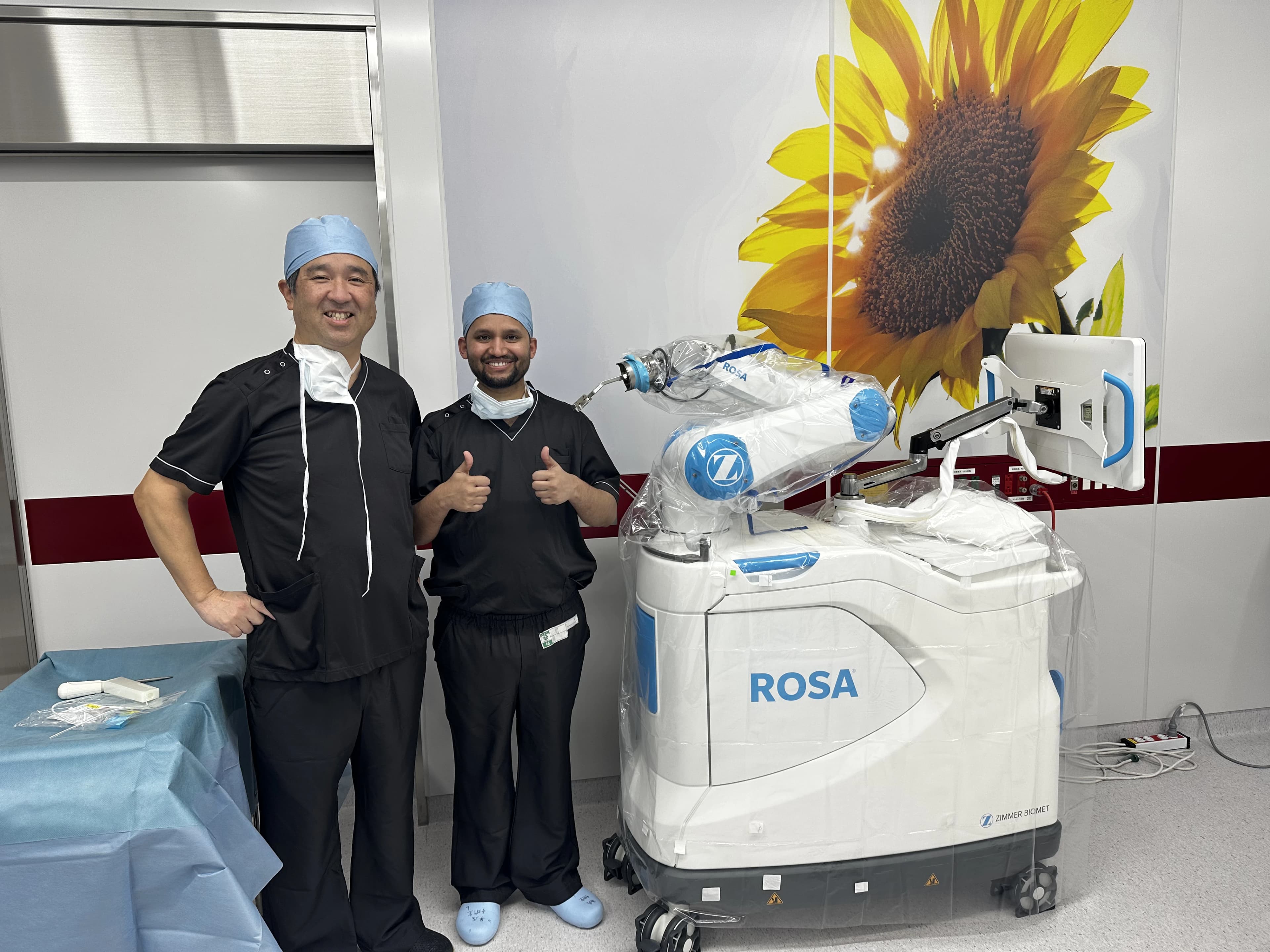
Intraoperative kinematics & 3D navigation alongside Japanese surgical faculty.
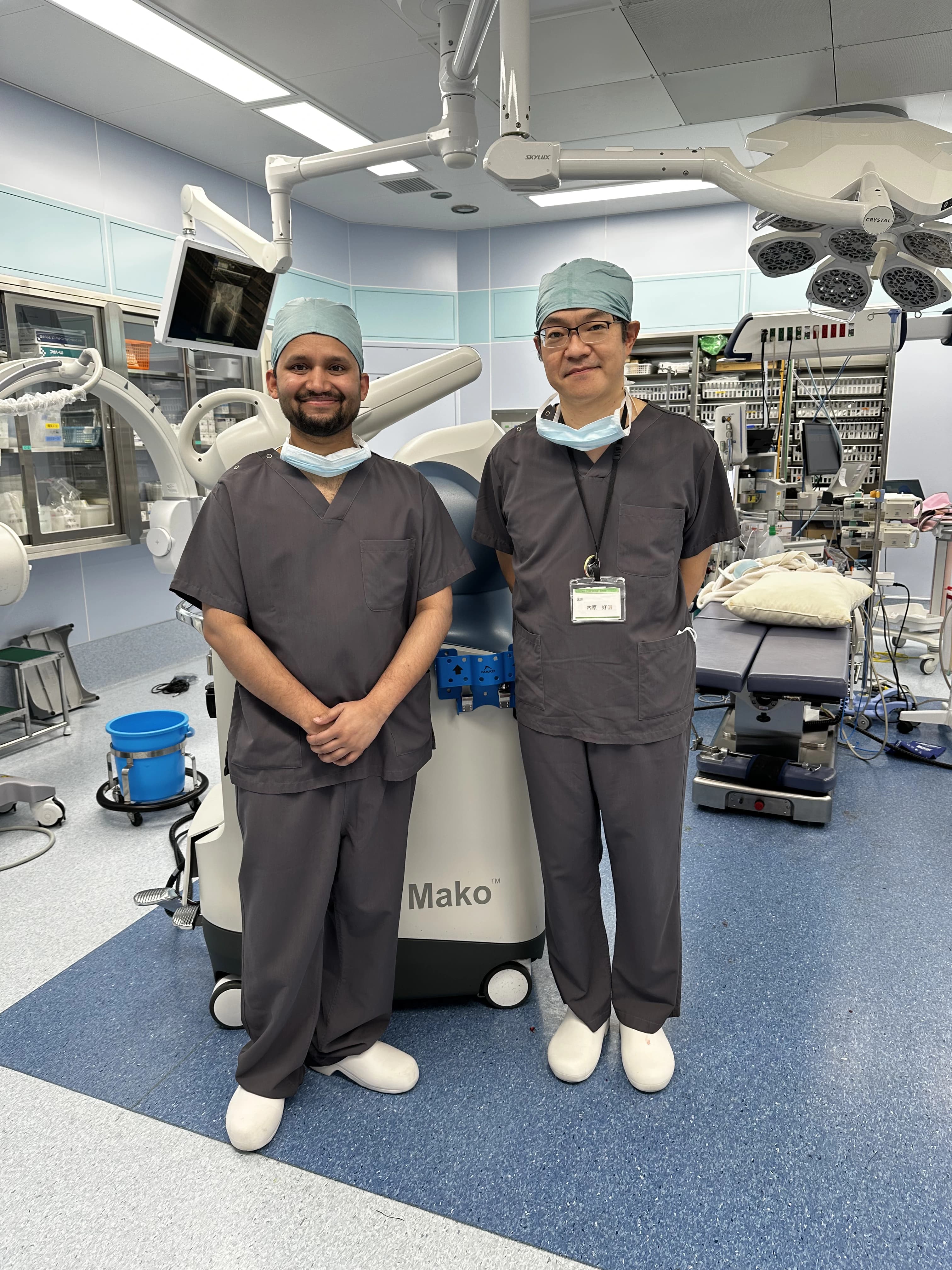
International fellowship-level precision applied to patient care in Patna.
Frequently Asked Questions on Robotic Joint Replacement
Robotic knee replacement is an advanced surgical technique where the orthopaedic surgeon utilizes 3D digital planning and a robotic arm to execute bone cuts and position the implant with sub-millimetre accuracy, avoiding unnecessary tissue damage.